

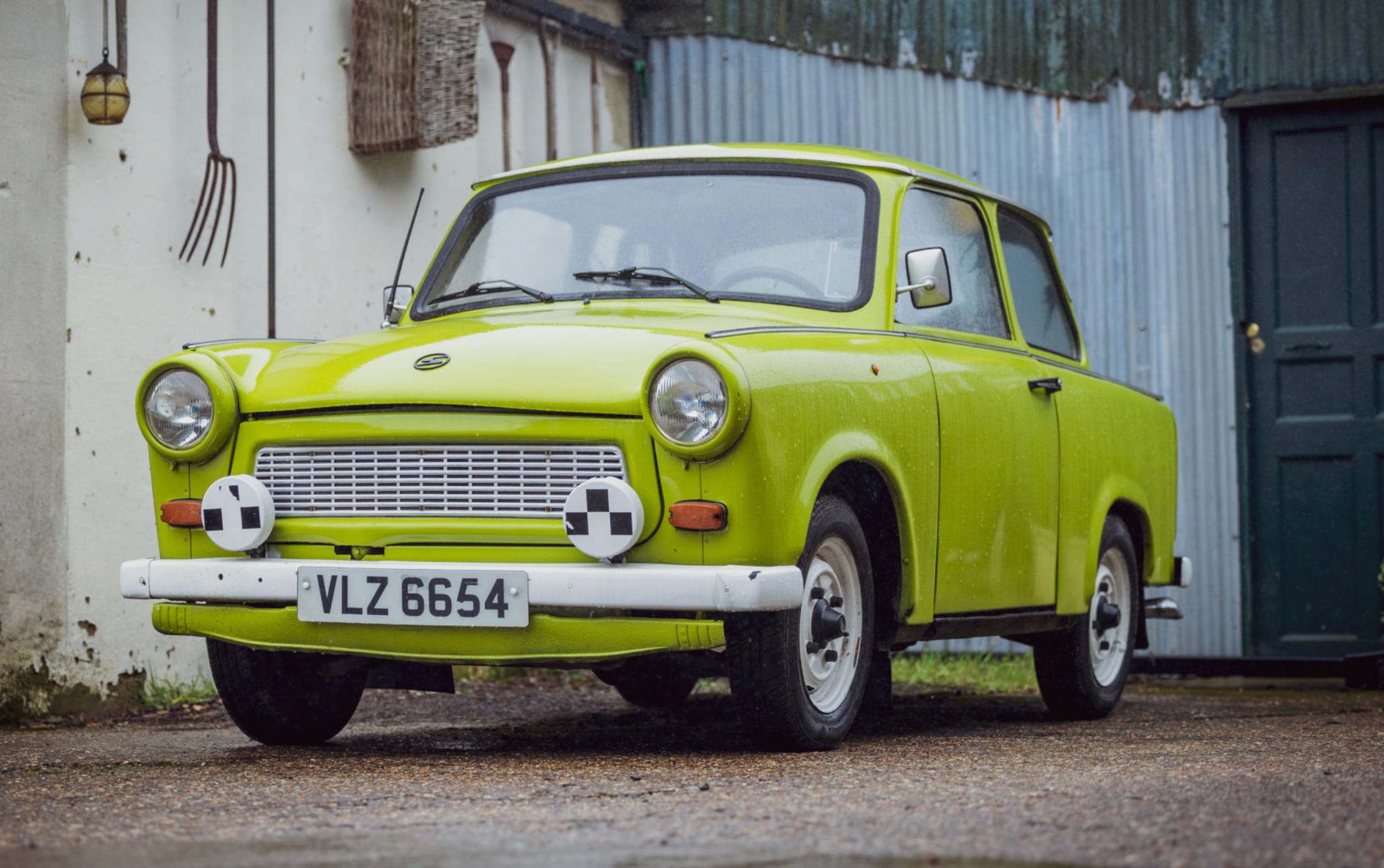
Few objects better capture the ambitions and contradictions of East German socialism than the Trabant. For decades, this small, boxy car dominated the streets of the German Democratic Republic (GDR), becoming both a symbol of socialist achievement and a quiet reminder of its limitations. To its designers and political sponsors, the Trabant represented the triumph of planned industry and egalitarian access. To many of its drivers, it was simply the only car they could reasonably hope to own. In this tension between ideology and everyday life, the Trabant emerged as the defining automotive icon of East Germany.
The Trabant’s origins lie directly in the postwar political settlement of Germany. After 1949, the newly formed GDR fell under the control of the Socialist Unity Party (SED), which sought to reorganize the economy along socialist lines. Heavy industry broadly, and transportation specifically, were all brought under state planning, guided by Five-Year Plans modeled loosely on the Soviet system. Within this framework, automobiles were not luxury consumer goods but rather national social goods. The SED envisioned a vehicle that could be produced in massive numbers cheaply and be accessible to the average teacher. In the mid-1950s, this vision materialized in the Sachsenring works in Zwickau, where engineers were tasked with designing a “people’s car” for socialism.
The result was the Trabant, first introduced in 1957. From the beginning, its development was shaped less by market competition than by political priorities. Scarcity of steel and foreign currency pushed engineers to innovate with unconventional materials, leading to the use of Duroplast, a plastic composite reinforced with cotton waste. The engine was a modest two-cylinder, two-stroke, chosen for its simplicity and low production cost rather than performance or refinement.
The Trabant’s timeline closely mirrors the trajectory of the GDR itself. Through the 1960s and 1970s, production steadily increased as the state invested in expanding output without fundamentally redesigning the vehicle. While Western automakers introduced new models every few years, the Trabant remained largely unchanged for decades, although additional models such as a station wagon were introduced in the 60s. In a system that prized stability and predictability, radical redesigns were risky and expensive. As long as the car fulfilled its basic function, planners saw little incentive to innovate. The Trabant thus became a frozen artifact of an earlier industrial moment, rolling unchanged into the late Cold War.
Ideologically, the Trabant was deeply connected to socialism’s promise of equality. Official propaganda portrayed it as a car “for everyone,” a tangible demonstration that modern mobility was not reserved for the wealthy. In theory, any East German worker could apply for a Trabant and eventually receive one at a fixed, state-controlled price. Ownership was not meant to signal status but participation in a collective standard of living. This egalitarian framing distinguished the Trabant sharply from Western automobiles, which were openly marketed as expressions of individuality, success, and taste.
In reality, however, access was far from immediate. Waiting lists for a new Trabant often stretched a decade or more, making the actual accessibility of the vehicle far more limited than the SED would have liked. Yet even this delay reinforced certain socialist values. Since prices were low and resale markets tightly controlled, speculation and luxury consumption were minimized. The car one received was almost always the same as everyone else’s, reinforcing the sense of standardization that defined everyday life in the GDR. Streets filled with near-identical Trabants, differentiated only by age and minor repairs.
The comparison with Western cars, particularly brands like BMW, demonstrates the ideological divide of the Cold War. While BMW emphasized engineering performance and prestige, the Trabant rejected these values outright. It was slower, louder, and technologically outdated, yet it was also cheaper and more widely distributed within its own system. Western observers often mocked the Trabant as a symbol of socialist backwardness, but such comparisons missed the point. The Trabant was never intended to “win” against BMW on performance. Its purpose was social rather than competitive, to demonstrate that socialism could provide basic modern goods without reproducing class distinctions.
By the late 1980s, however, the gap between ideology and reality became increasingly difficult to ignore. East Germans were acutely aware of Western automotive advances, visible on television and, for some, through travel. The Trabant’s obsolescence became a quiet source of dissatisfaction, emblematic of a system unable to advance. When the Berlin Wall fell in 1989, images of Trabants crossing into West Germany became iconic, representing decades of constrained choice suddenly giving way to abundance.
Ultimately, the Trabant stands as a powerful symbol of East German socialism. It succeeded on its own terms by providing mass mobility and reinforcing ideals of equality and standardization. At the same time, its limitations exposed the costs of insulating production from competition and consumer feedback. Like the GDR itself, the Trabant was functional and orderly, yet increasingly out of step with a changing world. Its legacy is not simply one of failure or ridicule, but also of a distinct social and economic experiment than existed in Central Europe for four decades of the 20th century.
Works Cited
DDR Museum. “The Trabant.” ddr-museum.de. DDR Museum, May 2, 2017.
https://www.ddr-museum.de/en/blog/2017/thema-verkehr-der-trabant.
Eli Rubin, The Trabant: Consumption, Eigen-Sinn, and Movement, History Workshop Journal, Volume 68, Issue 1, Autumn 2009, Pages 27–44, https://doi.org/10.1093/hwj/dbp016
Hamer, Tony, and Michele Hamer. “The Historical Significance of the Trabant Classic German Automobile.” liveabout.com. LiveAbout, April 19, 2018.
https://www.liveabout.com/trabant-built-of-plastic-and-socialism-726030.
Koscs, Jim. “Maligned and Misunderstood, East Germany’s Tiny Trabant Left an Outsized Legacy.” hagerty.com. Hagerty Media, October 4, 2021.
https://www.hagerty.com/media/car-profiles/maligned-and-misunderstood-east-germanys-tiny-tra bant-left-an-outsized-legacy/.
T Mills, Kelly. “The Trabant.” Rrchnm.org. Making the History of 1989, May 28, 2021. https://1989.rrchnm.org/items/show/672.html.

See this is the kind of car history I love