
The Rise of Fascism in Nazi Germany: A Historiographical Approach
How and why did Nazism arise in 20th-century Germany? Relatedly, why did Nazism win compared to other radical alternatives?

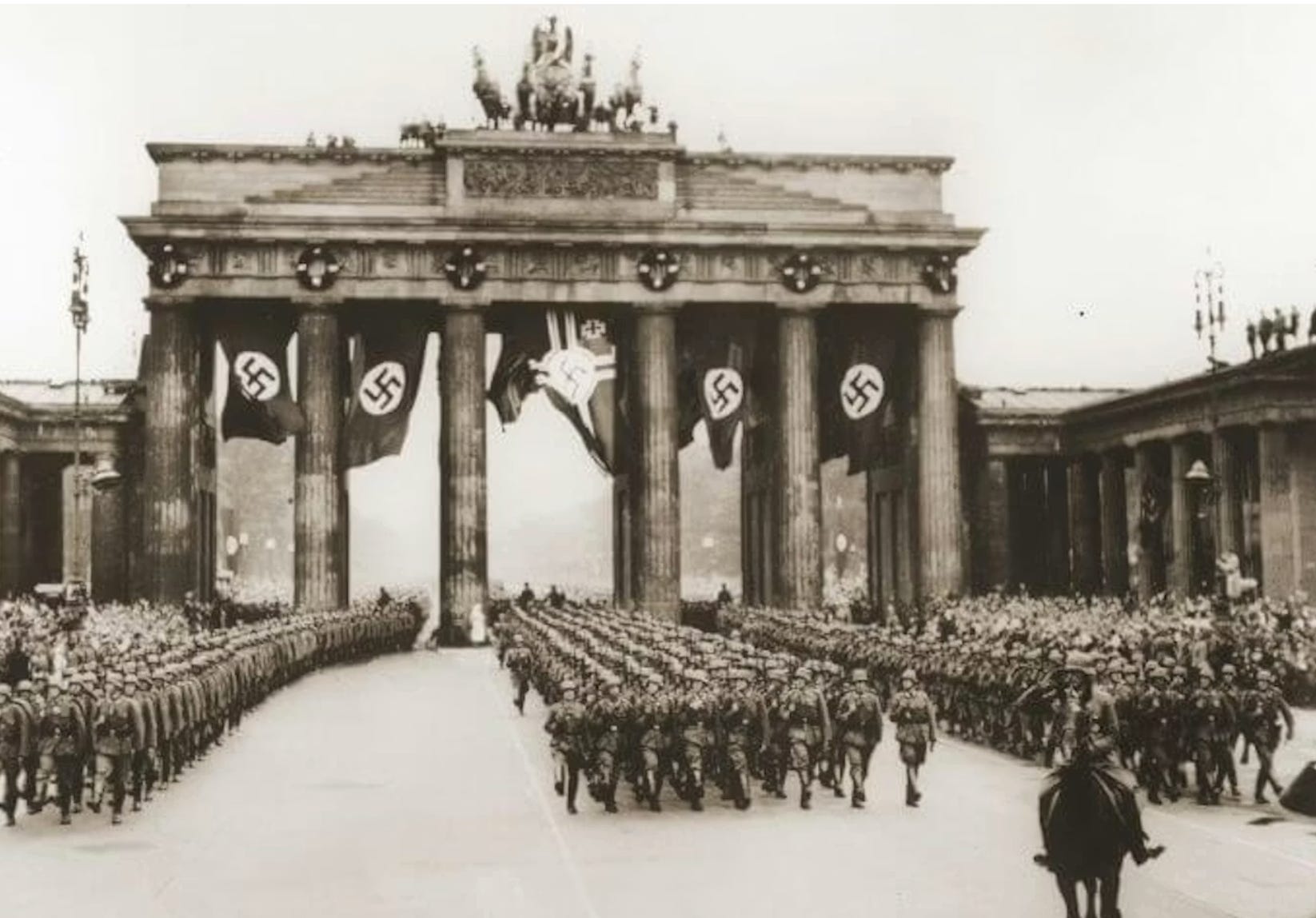
After the fall of the Soviet Union in 1991, there was hope for a “New World Order,” where liberal democracy would reign supreme across the globe. Since then, the world has become less and less democratic. 72% of the population now lives under autocratic rule, and authoritarian regimes and rhetoric continue to appeal to voters. The strength of these movements feed off of economic uncertainty, cultural erosion, and a general fear of the modern way of life. Hitler’s rise to power can be explained by many of those same factors. As engaged citizens of the world, it is important to understand why these ideologies become so popular. The essay will tackle the question: how and why did Nazism arise in 20th-century Germany? Relatedly, why did Nazism win compared to other radical alternatives? To do this, I will compare J.S. Conway’s Due Process of History with Bessel’s Life in the Third Reich. Conway’s paper is structured not as one argument, but rather an examination of various explanations. The argument I will make is that Nazism, aided by a lack of faith in liberal democracy and a political system favorable to the success of fringe parties, arose because it was seen as the only appealing alternative to other radical options.
An Introduction to Conway’s Evidence
According to Conway, many Nazi sympathizers and conservative historians pushed the view that the rise of Nazism can be explained by the lack of viable alternatives. While this perspective is sometimes rooted in the desire to alleviate responsibility from the German public, it has significant evidence and deserves evaluation. Following the Treaty of Versailles after World War I, Germany fell into a massive economic collapse: on top of suffering huge strategic losses, such as demilitarizing the Rhineland, Germany entered a period of hyperinflation. The German currency crumbled in value, and everyday citizens walked the streets with wheelbarrows of money just for a standard trip to the store. Entering the 1930s, the German populace wanted swift and dramatic change. Conway cites Erich Eyek, a German historian, to explain why a more moderate alternative to Nazism was unrealistic: “According to Erich Eyck, the world economic crisis and the earlier German inflation … had the effect of undermining the German middle-classes’ confidence in the effectiveness of the moderate political parties, and induced them to rely increasingly on a party which offered decisive action to remedy their economic distress.” The Nazi Party offered decisive action in a way that other alternatives did not. He continues: “It was these economic causes rather than the inapplicability of their ideas which liberals believed was the basic cause of the seduction of Germans away from democracy.” Later in the paper, Conway cites the idea that “the big concerns which supported Hitler’s rise to power consisted mainly of [the] groups which had been hardest hit by the depression and thus hoped for the coming of a saviour.” Just like today, everyday Germans lost confidence in the political system’s ability to solve their problems, and thus placed their hope in an anti-democratic, yet charismatic, leader.
Amongst the various radical alternatives to liberal democracy, why did Nazism arise as opposed to a Leftist ideology?
The German people were done with liberal democracy: just like today, the failures of large bureaucracy, slow governance, and dwindling economic confidence had left politics increasingly radical, polarized, and authoritarian. If this were true, and there were going to be a radical alternative to liberal democracy, there is a natural follow-up question: Why did Nazism win over Communism to begin with?
One answer that Conway points to is an inherent bias against Communism that existed within the German population: “Only the smallest fraction of the public had enough power of political imagination to be able to foresee the kind of consequences that would follow an elimination of constitutional guarantees and the disbanding of the democratic system.... Wide circles of the public unblinkingly accepted actions of national-minded men that, had the same actions being undertaken by Communists, would have been considered alarming violations of justice and order.” Though Communism, like Fascism, offered dramatic change to a country in strife, there was simply too much anti-Communist sentiment in Germany at the time. Conway also poses the argument that the wealthy industrialists of Germany played a large role in Hitler’s rise to power, as Nazism, while imperfect, was understandably far more appealing in their eyes compared to Communism: “The big industrial concerns, while welcoming Hitler as an ally against Labor, would have preferred to see him being used as a mere tool in the hands of a Cabinet controlled by industry. When this proved not to be feasible, however, they supported Hitler as the lesser of two evils, eager to make the best of his coming to power both politically and economically.” The influence of these industrialists can be seen within the particularities of the German political system. In order to keep the ever more popular Communists out of power, Hitler had to maintain a very large party within the Reichstag, and had to make deals with political power brokers in doing so: “In October I93I the industrialists brought direct pressure on Hindenburg to have the Cabinet reshuffled still more in accordance with their wishes. As the number of Communist sympathizers continued to rise during 1932, there was ever greater need to purchase the support of a mass party to offset the Bolshevist menace.” It was clear that the failures of the German state had eroded the people’s faith in liberal democracy and stable institutions, and a big shift was coming. However, Conway correctly addresses other factors that made Leftist solutions impossible, thereby paving the way for Nazism to come to fruition.
Bessel’s Argument
Bessel instead focuses on the fundamental nature of left wing politics that left it vulnerable to the rise of Fascism: he suggests that Nazism was inevitable. He asserts that “the idea that a united Left would have survived the onslaught of the Nazis and their conservative allies… was at best a pipe dream.” Later, Bessel claims that “if the history of the Nazi seizure reflects anything about left-wing politics, it is that there is little the Left can do to stop a powerful right-wing movement which has mass support, allies in powerful places, and control of the repressive apparatus of the State.” There are some similarities in Conway and Bessel’s arguments respectively, as they both acknowledge the powerlessness of the Left in relation to a movement like the Nazi Party, albeit for slightly different reasons.
Interestingly, while Bessel and Conway both make compelling arguments about the Nazi rise to power, they perhaps focus too little on the role of the German political system itself. German elections featured a multi-party system that allowed for more fringe parties like the Nazi Party to have an outsized chance to take control of the government. When the Nazis eventually came to power in the early 1930s, they only took 37% of the vote. However, due to the fragmented politics of Germany, this was enough to hold a plurality in the Reichstag. At the time, the Nazi opposition on the Left was divided between the Communists and the Social Democrats, and made up about 35% of the total vote: slightly less than what the Nazi Party was able to receive. However, when incorporating the 12% of the population that voted for the “Centre” Party, the Nazis could have been stopped from taking power. The Centre Party was historically quite Catholic and had at times formed coalitions with the Social Democrats. A united coalition of the Centre, the Social Democrats, and the Communists could’ve actually kept the Nazis from holding a majority 1932, thus casting some doubt on Bessel’s earlier claim that a united left could not have withstood the Nazi onslaught. If the political spectrum from the far-left through the center-right could have properly organized, the data shows that a Nazi defeat was not in fact a “pipe dream.”
The conditions that allowed the Nazis to come to power are not identical to those that exist today, but certain things remain constant. In the Bible, Ecclesiastes wisely points out that “there is nothing new under the sun,” and thus understanding the Nazi rise to power is and always will be a valuable research question for decades to come.
Bibliography:
Bessel, Richard. Life in the Third Reich. Oxford, Oxford University Press, 2001.
Conway, J. S. “‘Machtergreifung’ or ‘Due Process of History’: The Historiography of Hitler’s Rise to Power.” The Historical Journal 8, no. 3 (1965): 399–413. http://www.jstor.org/stable/3020433.