

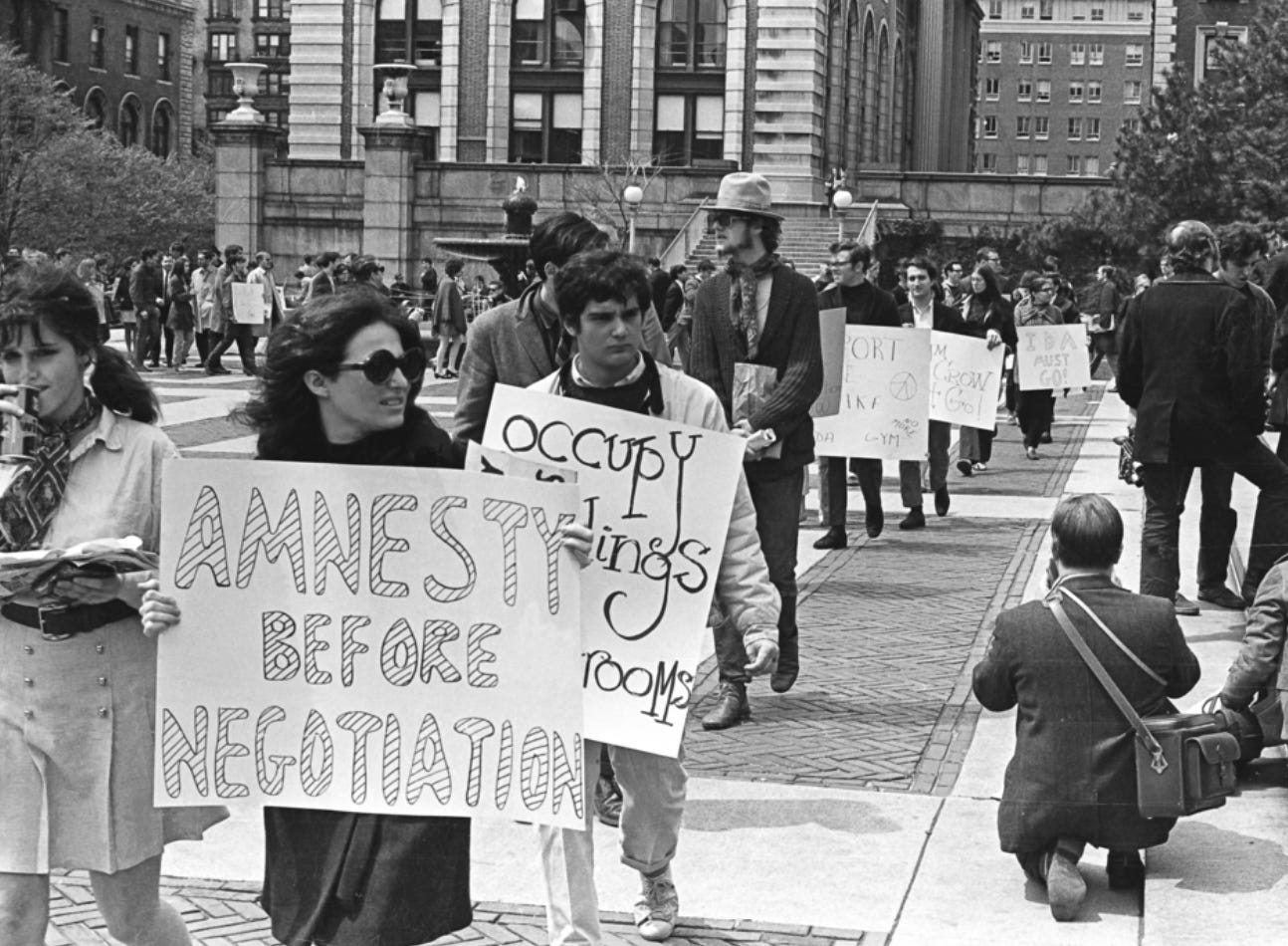
Left internationalism is an ideology that champions egalitarian and revolutionary rhetoric on an international scale. This essay will evaluate the extent to which left internationalism pervaded within advocacy groups during the 1968 Columbia protests, using one specific document as a microcosm. The document I will analyze comes directly from Columbia University’s historical archives, which I gained access to through my Contemporary World History course. Here is the document, typed out:
“Today Third World students and community people from all over the city are coming to this campus to express solidarity with the brothers and sisters in the Third World Center in Hamilton Hall and with all Columbia people who have been on strike. Some people on this campus have mistakenly viewed the community related demands as somehow divisive and unrelated to the main focus of the strike – the war. Nothing could be further from the truth. U.S. imperialism must be fought on all fronts. We express solidarity with the Third World students when they said yesterday:
We celebrate the struggle of oppressed people throughout the world, particularly the advances of the Indochinese people in their battle against U.S. imperialism. We express our solidarity with all progressive forces against oppression and call once again for those on this campus who are not part of the oppressive machinery to assume a responsible position and return to the strike. We will hold an anti-imperialist rally on Tuesday, May 2, at 1:00 p.m., at the sundial.
Only by uniting with Third World students and community people can an effective force be forged that will smash the war machine. This machinery of profit and death oppresses not only the Indochinese but Third World peoples in America. Our own struggle for liberation is inseparable from that of the Indochinese peoples. Our strength is in unity. We call on all white students to join with their Third World brothers and sisters today.
HAMILTON – KENT COLLECTIVE
MASS MEETING TONIGHT AT 8:00 P.M. Hewitt Lounge Ferris Booth
Flash!
J. Edgar Hoover is dead.ALL POWER TO THE PEOPLE”
The author of this specific Columbia protester channeled left internationalist rhetoric, highlighting a shared struggle of all oppressed third world peoples. An important facet of this type of political thought is that the struggle for equality should not just be fought within one state, but across borders and countries: In the same way that Marx and Engels shout “Working Men of All Countries, Unite,” the author of this document ends his letter with: “Our own struggle for liberation is inseparable from that of the Indochinese peoples. Our strength is in unity” (Box 11, Folder 21). The influence of leftist rhetoric is clear, and informs the worldview of the Columbia protestors.
Interestingly, the language used in this document also reflects Marxist rhetoric. Key to Marxist political thought is the hierarchical division of human groups into classes, with an underlying power dynamic controlling the hierarchy. The author of this document applies a Marxist framework to his current life experience: Instead of referring to a proletariat class as Marx would, the author mentions the Third World as the class of oppressed peoples. He juxtaposes the Third World students with “the war machine” instead of “the bourgeoisie.” He does so by explaining that the machine “oppresses not only the Indochinese but Third World peoples in America” (Box 11, Folder 21). He continues by advocating for the smashing of said war machine, in the same way that the Luddites, as an example, smashed machinery during the industrial revolution. Given that the war machine is a general metaphor for the Western establishment, the call to smash it is clearly a revolutionary call. Marxism, by definition, also champions a revolution against the oppressive establishment. In addition, central to a Marxist framework is also anti-capitalism, which the author includes: he expands on his war machine analogy by calling it a “machine of profit and death” (Box 11, Folder 21). The author sees a link between war and profit, suggesting that there is a financial incentive for the waging of war in Vietnam. This perceived conflict of interest adds to the general anger directed towards the U.S. military and its adjacent institutions, such as the ROTC and IDA. The language used in this document is not unique. For instance, in another letter, Columbia student Mr. Jomo Raskin similarly refers to the University’s military-oriented institutions as a “racist and imperialist scheme” (Box 11, Folder 21). Mr. Raskin also, in several places, calls for revolution. Both of these statements align with the egalitarian and revolutionary rhetoric consistent with extreme left internationalism. In order to understand the point of view of the more radical protesters, we must understand the lens through which they view the world.
One limitation of this document is that it presents one of the more extreme viewpoints held by Columbia students. In addition to using leftist language throughout the letter, the author ends by writing “ALL POWER TO THE PEOPLE” (Box 11, Folder 21) instead of signing his name. The rhetoric is clearly anti-establishment, as it implies that power must be removed from one party and transferred to another. More conservative or establishment students would be disillusioned with the radical change that the author calls for. Therefore, this document appealed to only a small, specific group of students at Columbia. In reality, there was a wide variety of viewpoints expressed by Columbia students, many of which were against the protests all together. For example, the very name of the “Majority Coalition,” which wrote strong letters against the anarchic tactics of the SDS, suggests that they felt most students were in fact against the violent protests. Additionally, the beliefs of the country as a whole were clearly opposed to the point of view expressed in the document: President Richard Nixon eventually won his 1968 campaign bid on a promise for “law and order,” which was a direct response to the violence and chaos of the 1960s.
Samson Cain, thanks for posting it. Such political discourse was commonly prevalent in the mid of the last century, time of cool war between the east where represented by Soviet Union from one side, and on the other side USA and its allies who representing the west. Over time, it can be said that what reverberated in the eastern camp was only unvaluable discourses and ballshit.
It is really so nice to study these historical documents in order to avoid mistakes.