

An Engineered Shipwreck
During the summer of 1848, a 24-year-old seaman drifted into the waters near the island of Rishiri in an open boat, by himself, off the shore of what would become the Japanese prefecture of Hokkaido. This man was named Ranald MacDonald, and he had orchestrated the whole process. Japan was a country closed to most of the world at this point due to its sakoku policy, and landing without permission meant either imprisonment or death for any foreigners who did so. MacDonald made it look like he had shipwrecked himself, and he was taken in by nearby Ainu locals and then turned over to Japanese officials in Nagasaki.
A Different Lineage
Macdonald did not fit the mold of an American who desired to explore out of pure curiosity. MacDonald came from a lineage in which his father was a Scottish fur trader, while his mother was Chinook, named Koale’xoa. His mother was a daughter of Comcomly, a notable Chinook from the lower Columbia River with diplomatic skills who had a talent for trading with the early Americans and Europeans.
Biographers claimed for decades that MacDonald’s interest in Japan began when he was a kid at Fort Vancouver, where he encountered three Japanese sailors stranded on the Pacific coast and rescued them with other soldiers from Fort Vancouver. Unfortunately, there is no evidence to support this claim; in fact, recent research shows that the Japanese sailors reached Fort Vancouver in July 1834, when MacDonald, then around 10 years old, left for another place in Canada.
The Nagasaki Classroom
Faced with an increasing number of American and British ships heading towards their waters and a shortage of Japanese speakers fluent in English, the Japanese government decided to take an extraordinary step. Far from considering him as a direct threat, they employed fourteen samurai interpreters, who had been taught only Dutch before, to study English under him. Classes took place in the place of his incarceration, a branch temple in Nagasaki, where he spent roughly seven months. There is one student in particular who distinguished himself with his ability to master English quickly. According to one historian, he was a real “language genius”: Moriyama Einosuke.
The Black Ships Arrive
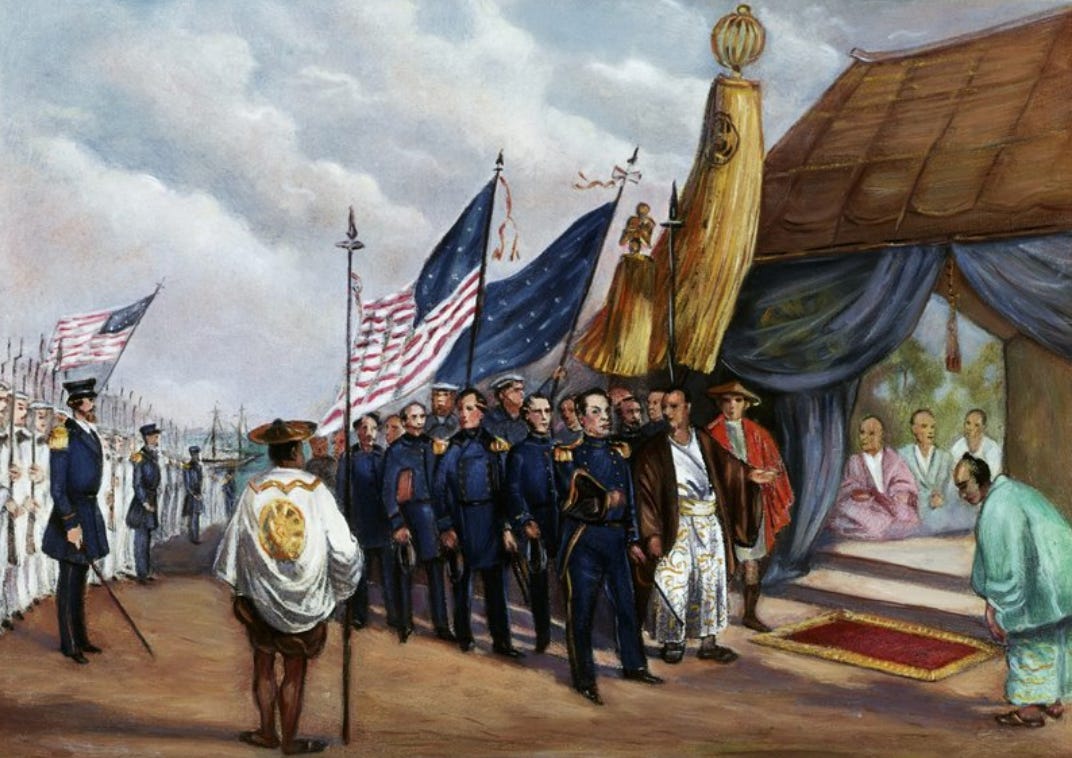
Five years later, in 1853, an American fleet led by Commodore Matthew Perry appeared at the entrance of Edo Bay, demanding that Japan open up its ports for trading or else face the consequences. Moriyama, MacDonald’s student, became the main interpreter of the shogunate during negotiations with Perry and, later, with Russian and British delegations as well. The English language, which MacDonald had taught Moriyama in the guarded room in Nagasaki, became the language that kept Japan from the war, which it had no chance to win anyway.
The role of the interpreters does not include setting the political course, and Japan’s decision to negotiate rather than fight must be attributed to many other political processes at the top of the shogunate. It is, however, interesting to reflect on the fact that Japan could actually conduct such negotiations, that it could comprehend the demands of Perry and reply accordingly because of the sequence of events triggered by one foreigner who decided to use his imprisonment productively.
Though Perry was not the first American to visit Japan or communicate with the representatives of the Japanese government, he was the first American to approach the country with such a great level of firepower that Japan had to react to it. In 1846, Commander James Biddle approached Edo Bay with two ships and a trade request but without any success. The thing that distinguished MacDonald from other sailors was not his being the first. His uniqueness was in the fact that he not only visited the country but stayed here for quite a long time to teach, leaving behind one of his students who would become central in the future encounter everyone remembers.
A Legacy Forgotten and Remembered
Japan managed to avoid the process of colonization, which destroyed many Asian countries in the nineteenth century, while it faced the threat of Perry’s visit and made necessary institutional changes soon afterward. However, the translator who played a crucial role in this process learned the English language from a person who showed his interest in a “closed” country rather than his fear of it, in a time when being interested in such a country could have cost him dearly.
MacDonald himself received little gratitude for anything he did. He wrote his book regarding this incident shortly after coming back home, yet no publisher agreed to publish it, and it was printed only in 1923, twenty-nine years after MacDonald’s death. He died in 1894 in a town in the east of Washington state, forgotten, trying for years to get some official recognition for his teaching, without getting any. Japan remembered MacDonald much longer than his own homeland.
Lessons for a Modern Era
However, this story shows us that deterrence will tell you how to avoid defeat in a conflict situation. It will not teach you how to avoid the conflict itself and how to exit from it without worsening it further.
As long as we live in the era of mistrust between great nations and of the online discourse dominated by stereotypical representations of “the other side,” the lesson of the story is obvious. The bridge that was of critical importance in 1853 was not constructed by the country possessing a powerful navy. It was built many years ago by two men who could have had reasons to consider each other foreigners and foes, but decided instead to devote their scarce time to studying and teaching each other.

Amazing!