

According to Bertrand Russell, “Hitler is an outcome of Rousseau; Roosevelt and Churchill of Locke.” To what extent was he correct?
Bertrand Russell once suggested that Adolf Hitler’s ideas stem from the philosophy of Rousseau, while those of Roosevelt and Churchill are rooted in the thinking of Locke.1 In this essay, I argue that Russell’s statement is only partially true. What does it mean to be an ‘outcome’ of a philosopher? While Hitler, Churchill, and Roosevelt’s policies show intellectual connections to Rousseau and Locke respectively, they are not direct outcomes. Instead, they are fundamental transformations of the original ideas. An ‘outcome’ of philosophical thought can manifest through direct adoption, adapted influence, or distortion, where concepts are reshaped for different purposes. Russell’s claim assumes continuity, but history reveals a disruption of ideas.
This complexity appears in both philosophical lineages. When later thinkers transform original concepts to serve different purposes, are these authentic developments, or a perversion of their ideas? Russell’s claim assumes that ideas retain their original meaning over time, rather than becoming fundamentally altered through reinterpretation and historical application. I further argue that these ideas were reshaped not because of loyalty to the philosopher’s intent but to serve a deeper tribal impulse: The desire to secure power and influence, to stay loyal to one’s own group and dominate others. This instinct to prioritize one’s own people acted as the unseen hand that transforms these abstract ideals into instruments of political purpose.
Both philosophers created vulnerabilities that enabled this distortion. Rousseau’s general will assumes moral absolutism, one collective right that all must follow, which allows later thinkers to brand dissent as immoral, going far past the ethical boundaries that he set. 2 Locke established broad principles without guidance on how to concretely implement them, creating space for selective interpretation. 3
Rousseau’s philosophy centers on human nature and social corruption. Humans are inherently good but become corrupted by society’s desires. This corruption arises from private property and social institutions, creating inequality and lost freedom. As Rousseau argued, “The first man who, having enclosed a piece of ground, bethought himself of saying ‘This is mine,’ and found people simple enough to believe him, was the real founder of civil society”–marking humanity’s departure from natural equality.4
His works ‘The Discourse on the Origin of Inequality’ and ‘The Social Contract’ explain how civilization introduced artificial inequalities. Individuals become subjugated to the general will, a collective force defining freedom not as personal choice, but as unity with the people’s will. “Man is born free; and everywhere he is in chains,” he famously declared, capturing the central paradox of human existence under social institutions. 5
Furthermore, Rousseau’s general will also established ethical boundaries that Russell’s supposed ‘outcome’ violated, requiring civic equality for all people, deliberative democracy, and universal inclusion. Rousseau envisioned true freedom through collective lawmaking. Freedom comes from obedience to laws individuals have prescribed for themselves, achieved through participating in the general will representing collective interest. Society should allow individuals to collectively determine laws, ensuring equality and freedom for all kinds of people.
However, Rousseau’s core assumptions created interpretive vulnerabilities. The moral authority of the general will and his anti-pluralist views left room for misinterpretation as ideas diffused. Originally grounded in democratic ideals, these concepts were reinterpreted to legitimize state dominance and suppress individual freedom through moral unity. By defining freedom as obedience to collective will while rejecting pluralism, Rousseau created a framework easily used to justify repression. This absolutism excluded moral compromise, positioning opposition as attacks on truth itself.
As the ideas of Rousseau diffused throughout history, they were reinterpreted in ways that diverged from his original democratic intent. His ‘general will’ was intended for democratic unity, however its abstraction and moral absolutism created an ideological rigidity that left room for distortion.
Philosopher Johann Fichte built upon this idea, redefining it in ethnonationalist terms by introducing the concept of ‘Volksgeist,’ or national spirit, positioning the state as the ultimate moral authority. Hegel further reinforced this idea, elevating the state to the position of the highest expression of ethical life, where one’s life only becomes meaningful through subordination and dedication to national unity. Other thinkers like Treitschke, Wagner, Gobineau, and Chamberlain deepened this shift, blending state absolutism with racial myth further glorifying the German people, culminating in Hitler’s fascist vision.6
What began as Rousseau’s theory of civic unity and democratic liberty was fundamentally repurposed. These ideas, once tied to Rousseau, were entirely reoriented to serve nationalism and racial purity. This was not a logical extension of his philosophy, but rather a radical distortion, enabled by the ambiguity and absolutism within Rousseau’s original framework.
Hitler’s Nazi regime enforced unity through race and violence. Hitler’s version of the general will replaced civic unity for all with racial conformity and state violence. The general will in Rousseau’s hands was a democratic ideal, but Hitler turned it into a mechanism for authoritarian control and ethnic exclusion.
This was evident in policies like the Nuremberg Laws, which stripped Jews of citizenship, and ‘Gleichschaltung,’ which removed pluralism in favor of ideological conformity. As Hitler wrote in Mein Kampf, “The state is a means to end… [of] a community of physically and psychically homogeneous creatures,”⁷ which reveals a vision rooted not in Rousseau’s inclusive civic unity, but in an exclusionary racial ideology that defined political legitimacy by ethnic sameness and vilified so-called ‘degenerate’ elements of society presented by the diversity of peoples, portraying them as unworthy of belonging.
Thus, while Rousseau’s absolutism aimed at moral clarity, it laid a philosophical groundwork exploitable by malevolent actors to reframe it into a justification for domination. Hitler co-opted the concept of collective will, not to promote civic unity, but to elevate a racially defined ‘people,’ the so-called Aryans, while systematically dehumanizing and persecuting those deemed decadent or alien, most notably, the Jews.
This transformation was not an accident–but a purposeful repurposing over time–driven not by philosophical allegiance, but by the will to power. As the ideas of Rousseau diffused, they instrumentalized Rousseau’s language to legitimize and increase the influence of their own peoples–a political project rooted in domination, conquest, and the elevation of a singular group, their own tribe. The moral vocabulary was Rousseau’s, but the underlying motive? The pursuit of total influence and exclusionary supremacy.
John Locke’s philosophy is based on ideas of empiricism. Central to his philosophy was his belief in the concept of ‘tabula rasa.’ Where all knowledge is acquired through experience and observation and not divine revelation or innate ideas. Additionally, Locke believed that every person is born with inalienable, natural rights: life, liberty, and property. These are the foundations of a legitimate government system, formed by the consent of those being governed to protect these rights. 8
However, Locke’s philosophy, while morally powerful, is philosophically broad and underspecified. His concepts of natural rights and government by consent are overly abstract and flexible due to the fact that he gave very little guidance on how these principles should be applied in different situations, leaving significant room for interpretation.
For example, his idea of ‘consent of the governed’ is ambiguous as he did not concretely define how such consent is obtained, measured, or maintained over time. His faith in just principles leading to just institutions underestimated how those same principles could be selectively applied or manipulated depending on political necessity or ideological intent.
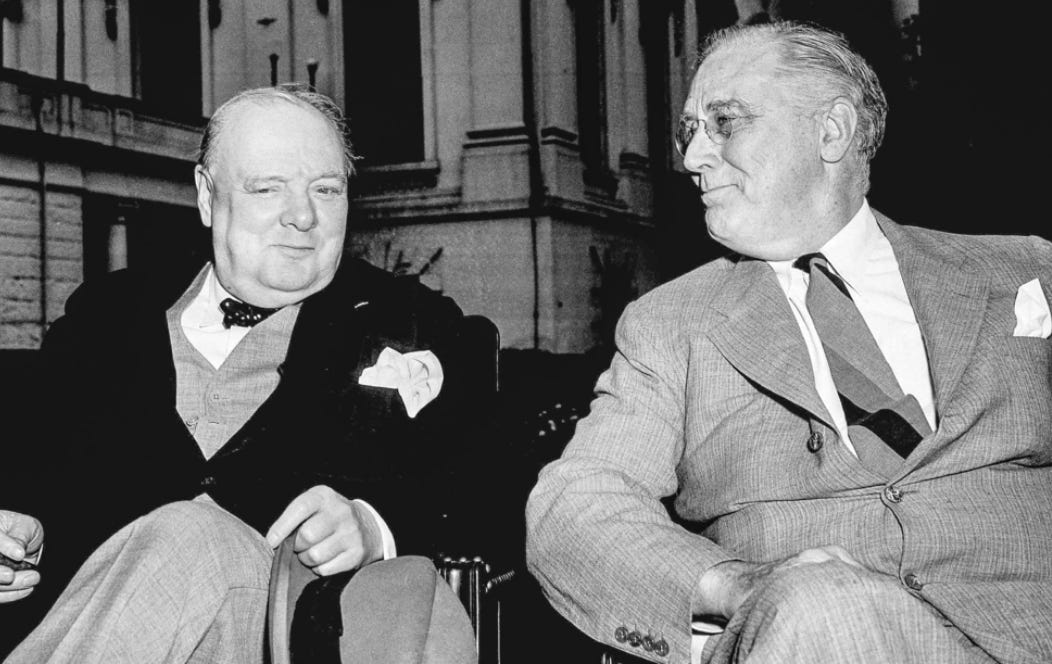
This malleability of ideas is evident in the political ideas and actions of both Winston Churchill and Franklin D. Roosevelt. While both were important advocates for liberal democracy, they also enacted policies that conflicted with and contradicted Locke’s original principles.
For instance, Churchill authorized the suspension of habeas corpus during WWII through Defense Regulation 18B, which allowed for the internment of individuals without trial.9 This directly contradicts Locke’s emphasis on due process and the sanctity of individual rights. Furthermore, Churchill’s defense of the British Empire and opposition to Indian self-rule violates Locke’s foundational idea that legitimate government must be based on the consent of the governed.
Domestically, Churchill upheld ideas of liberty, yet abroad, he maintained colonial dominance, showing a selective application of Locke’s supposedly universal principles. This demonstrates how Locke’s broad framework could be interpreted to justify contradictory positions depending on political context and necessity. Churchill’s selective application of Lockean shows how he is impacted by a desire to elevate his own group of people, his tribe. His vision of liberty was not universal but bounded by what he saw as civilizational hierarchy. He extended sovereignty to those he deemed capable of self-governance while maintaining a tight grip over those he considered racially or culturally inferior. Like Hitler’s exploitation of the collective will to elevate the Aryans, Churchill elevated the English civilization as the natural bearer of liberty, treating Indian independence not as a right, but as a threat to the natural rights Locke proposed.
Roosevelt also diverged from Locke’s philosophy through his actions and policies, though in different ways. In his Four Freedoms speech, Roosevelt introduced concepts like ‘freedom from want,’ expanding the meaning of liberty to include economic security. This shifts from Locke’s idea of liberty as freedom from government interference to a more proactive role of the state in ensuring welfare. Moreover, his most stark violation of Lockean principles emerged through actions such as Executive Order 9066, forcibly evacuating over 120,000 Japanese-Americans from the West Coast. It was enacted without explicit public consent, challenging Locke’s principle that governmental power must protect the natural rights of all individuals and is justified through the consent of the governed. 10 This clearly reveals the selective nature of Roosevelt’s commitment to the natural rights of all people: while championing freedom and democracy for white Americans, he systematically denied life, liberty, and property to those he deemed outside the national tribe.
Thus, Roosevelt’s departure from Lockean limitations stemmed not just from economic necessity but from a tribal understanding of American exceptionalism. The New Deal represented a desire for power of a particular version of American identity. One that expanded federal authority to protect his group of people against economic forces. Japanese-American internment camps serve as the clearest example of how tribal impulses could override the very Lockean principles he claimed to defend. The Four Freedoms speech reveals this tribal aspect: freedom was to be secured for Americans and their allies, where economic nationalism and wartime policies showcase how quickly universal principles could be subordinated in order to prioritize group survival and dominance.
Both leaders, despite operating within Lockean frameworks, ultimately deviated from his ideas by subordinating abstract principles to tribal loyalties. Churchill to imperial civilization, Roosevelt to American nationalism. This tribal desire for power manifested not as philosophical consistency, but as the pragmatic use of ideas to advance their respective peoples’ interests.
Therefore, the core flaw in Russell’s statement lies in its assumption of direct outcome, rather than acknowledging the multifaceted process of reinterpretation. Rousseau’s belief in a singular moral general will, a form of moral absolutism, enabled later authoritarian thinkers to suppress dissent in the name of virtue. Locke offered a highly abstract conception of natural rights and government by consent, but his failure to specify implementation allowed vastly different interpretations to emerge.
Ultimately, Russell’s assertion that Hitler stems from Rousseau, and Roosevelt and Churchill from Locke, captures a partial glimpse of the truth, but oversimplifies the relationship between philosophy and historical action. While the ideas of Rousseau and Locke influenced later political developments, the transformations they underwent through time and context mean that Russell’s statement should reflect correlation rather than direct philosophical causation, leaving him only partially correct.
They diverged from these philosophical principles not merely out of misunderstanding, but because of a deeper, more fundamental desire for control, legitimacy, and historical influence. In this light, Rousseau and Locke provided lofty ideas as tools to be used as pretext for the return to something far more primal.
Beneath the surface of enlightenment and reason lay the ancient impulse to dominate, to reassert the tribe over the individual, and to bend ideology to serve ambition.
References:
Russell, Bertrand. History of Western Philosophy. Simon & Schuster, 1945.
Rousseau, Jean-Jacques. The Social Contract. Translated by Jonathan Bennett, Early Modern Texts, 1762, pp. 6-54. https://www.earlymoderntexts.com/assets/pdfs/rousseau1762.pdf.
Griffith, Mark F. “John Locke’s Influence on American Government and Public Administration.” Journal of Management History, vol. 3, no. 3, 1997, pp. 224–237. https://doi.org/10.1108/13552529710181578.
Rousseau, Jean-Jacques. Discourse on the Origin and Basis of Inequality Among Men. Translated by Ian Johnston, ETH Zurich, 2009, pp. 11–31. www.files.ethz.ch/isn/125494/5019_Rousseau_Discourse_on_the_Origin_of_Inequality.pdf.
Rousseau, Jean-Jacques. The Social Contract. Translated by Jonathan Bennett, Early Modern Texts, 1762, pp. 6–54, https://www.earlymoderntexts.com/assets/pdfs/rousseau1762.pdf.
Shirer, William L. The Rise and Fall of the Third Reich: A History of Nazi Germany. Simon & Schuster, 1960, pp. 97–113.
Bengtsson, Staffan. “The Nation’s Body: Disability and Deviance in the Writings of Adolf Hitler.” Disability & Society, vol. 33, no. 3, 15 Jan. 2018, p. 9, https://doi.org/10.1080/09687599.2018.1423955.
Locke, John. Two Treatises of Government. Edited by Rod Hay, vol. V in The Works of John Locke. A New Edition, Corrected, printed for Thomas Tegg et al., 1823. York University, 2025. PDF, pp. 105–167, https://www.yorku.ca/comninel/courses/3025pdf/Locke.pdf. Accessed 9 June 2025.
Hansard, UK Parliament. “Defence Regulation 18B (Re-Consideration).” 16 June 1944. https://hansard.parliament.uk/Commons/1944-06-16/debates/863d990b-64d6-47cd-a24b-2db8b12b37f0/DefenceRegulation18B.
Schumacher, Luke J. “Franklin D. Roosevelt, World War II, and the Reality of Constitutional Statesmanship.” Texas National Security Review, 9 May 2024. https://tnsr.org/2024/05/franklin-d-roosevelt-world-war-ii-and-the-reality-of-constitutional-statesmanship/.
